2026-07-08
Thamar University Organizes a Cultural Symposium Entitled "Ashura A Project for the Revival of a Nation"
□ Thamar University Media | Muharram 23, 1448. July 8, 2026
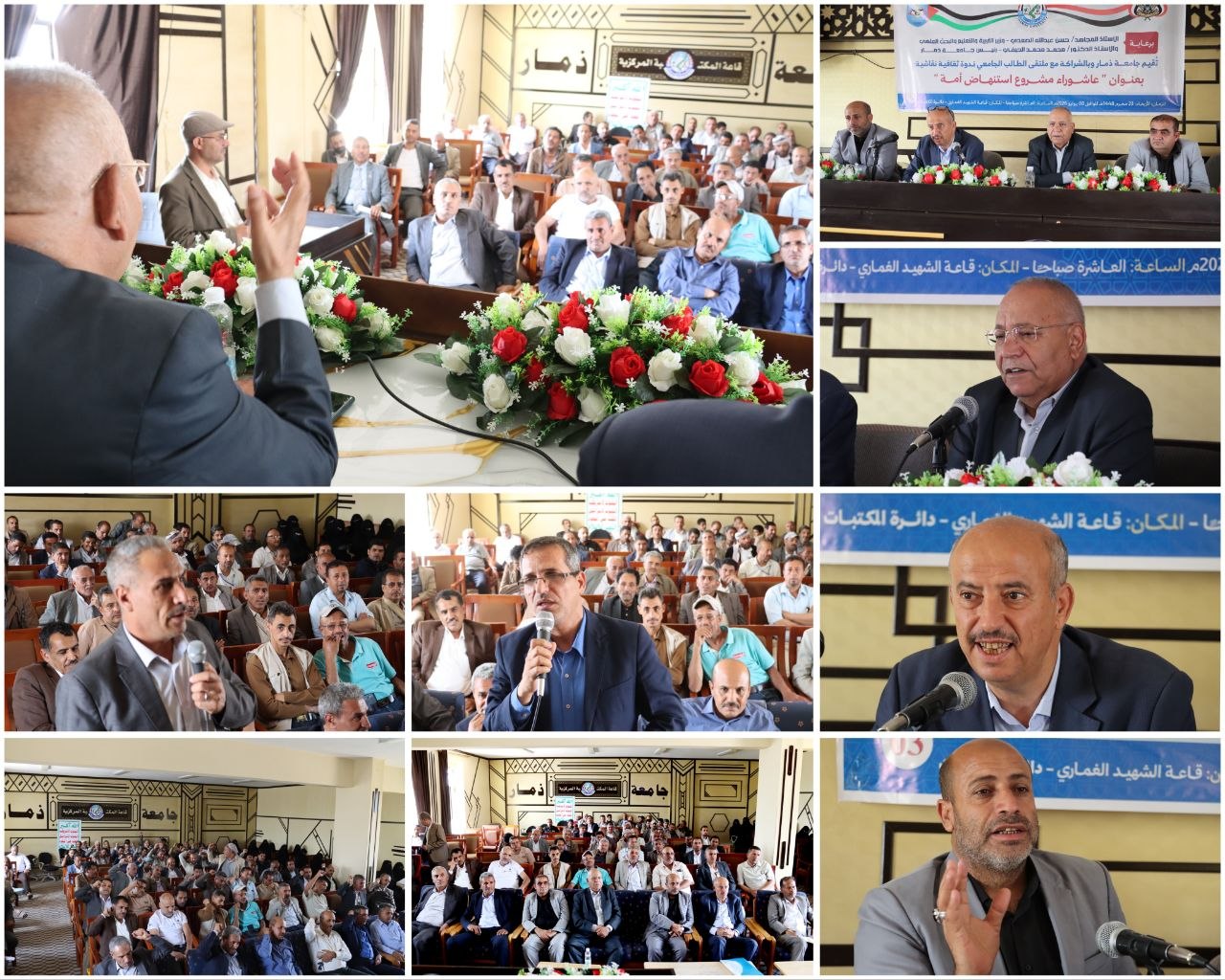
■ Under the patronage of Mr. Hassan Abdullah Al-Saadi, the Minister of Education and Scientific Research, and Professor Dr. Mohammed Mohammed Al-Haifi, the Rector of Thamar University, in partnership with the University Student Forum, organized the third cultural symposium of the academic year 1448, entitled "Ashura: A Project for the Revival of a Nation." The symposium was held in the Martyr Al-Ghamari Hall at the Library Department, with the attendance of university leaders, faculty, administrators, and students.
At the opening of the symposium, the University Rector Professor Dr. Mohammed Mohammed Al-Haifi delivered a speech welcoming the attendees and praising the concept of interactive cultural discussion seminars and their role in promoting cultural and intellectual awareness. He also commended the organizing committee's efforts in preparation and organization, emphasizing that this symposium represents the third major event organized by the university during the first month of the academic year 1448, as part of its plan to revitalize cultural and intellectual activity within the university.
During the symposium, Professor Dr. Abdulkafi Al-Rifai, the Vice-Rector of the University for Student Affairs, presented the keynote paper, addressing the symposium's theme from its various historical, intellectual, and practical dimensions. He reviewed the historical sequence of events preceding and following the Battle of Ashura, and the major transformations it brought to the course of the Muslim nation.
He also examined the historical and contemporary changes connected to this theme, explaining how the revolution of Imam Hussein ibn Ali (peace be upon him) constituted a pivotal moment in confronting political and intellectual deviations, and how it remains present in Islamic consciousness as a renewed project for the revival of the nation and the restoration of the values of justice, dignity, and reform. He also provided a detailed explanation of Imam Hussein's status with the Prophet Muhammad (peace and blessings be upon him and his family), and how his life embodied a close connection to the Holy Quran and its principles, emphasizing that Ashura is not a fleeting historical event, but rather an enduring school of thought in awareness, revival, and action.
Mr. Hassan Al-Mawshki, the University Rector's Consultant for Cultural Affairs, also delivered a presentation on the significance of Imam Hussein's sacrifices and their relevance to contemporary realities. He discussed his vision for the continuation of the resistance movement in several countries in the region, including Yemen, Iran, and Lebanon, considering it an extension of the values embodied by Imam Hussein's revolution.
The seminar, moderated by Dr. Essam Wasel, the University Rector's Assistant for center affairs, featured presentations by Dr. Hussein Al-Manjar, the Vice Dean of the Faculty of Administrative Sciences, and Abdulghani Al-Hajjaji, the University's General Director of Financial Affairs. They addressed their perspectives on the challenges facing the Muslim world, discussing the role of Jews and hypocrites in attempts to weaken the Muslim community throughout history. They argued that many of the conflicts and crimes witnessed in some parts of the Islamic world today stem from these challenges and are a reflection of these conspiracies.
The seminar, attended by Dr. Mohammed Hutrum, the University's General Secretary, his assistants, several deans and their deputies, department heads, general directors of general administrations, and a number of university leaders and academic and administrative staff, included discussions and interventions from participants.
These emphasized the importance of continuing to hold cultural and intellectual seminars that contribute to raising awareness, promoting a culture of dialogue, and instilling values and principles in university members, thus serving its academic and enlightening mission.