The Sixth International Conference on Emerging Smart Technologies and Their Applications, Thamar University, in Partnership with "Yemen Research", Brings Together Researchers on a Global Scientific Platform to Foresee the Future of Smart Technologies
The Sixth International Conference on Emerging Smart Technologies and Their Applications, Thamar University, in Partnership with "Yemen Research", Brings Together Researchers on a Global Scientific Platform to Foresee the Future of Smart Technologies
□ Thamar University Media | Jamal Al-Bahari | Safar 16, 1448. 30 July 2026
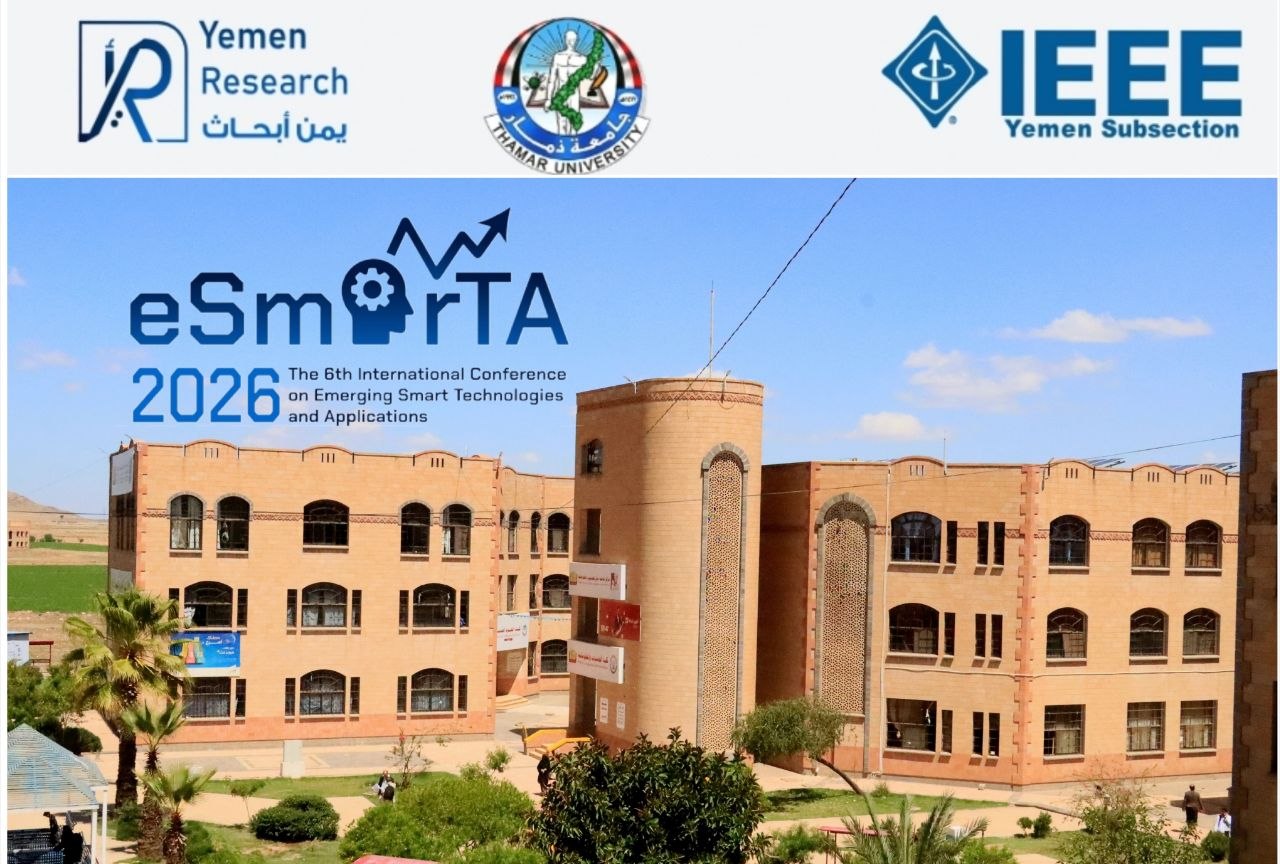
The Sixth International Conference on Emerging Smart Technologies and Their Applications (eSmarTA-2026), held from 4–5 August 2026 at Thamar University, in partnership with "Yemen Research", and under the patronage of Prof. Dr. Mohammed Mohammed Hassan Al-Haifi, the Rector of Thamar University, embodies the University's vision of establishing a scientific environment open to the world, and enhancing its presence on the international research map. This is achieved by attracting a distinguished cohort of researchers, academics, and experts from universities, research centres, and various scientific institutions within Yemen and abroad, to participate in a high-quality scientific event that merges academic originality with modern technological applications.
The conference witnesses broad international scientific participation, with researchers representing universities and research institutions from Arab, Asian, European, and African countries, presenting dozens of peer-reviewed scientific papers addressing the latest research findings in the field of emerging smart technologies. This reflects the growing scientific stature of the conference and the international confidence it commands, and underscores the success of Thamar University in establishing a global research platform for scientific dialogue and the exchange of expertise.
The conference proceedings are distributed across twelve specialised scientific sessions held over two days, with six sessions per day, discussing (96) peer-reviewed scientific papers presented by researchers from local and international universities and research institutions. The sessions are moderated by a distinguished group of professors and experts, with both in-person and virtual participation options available, thereby enhancing scientific communication and the exchange of expertise among researchers from various countries worldwide.
The scientific papers presented cover a broad spectrum of advanced research topics, foremost among which are: Artificial Intelligence, Deep Learning, Data Science, Large Language Models, Arabic Language Processing, Computer Vision, Cybersecurity, Cyberattack Detection, Smart Medicine, the Internet of Things, the Internet of Vehicles and Unmanned Aerial Vehicles, Robotics, Cloud Computing, Software Engineering, Smart Networks and Communications, 5G and 6G Technologies, Quantum Computing, Digital Twins, Smart Energy, Smart Cities, Industrial Systems, and Sustainability, in addition to smart applications in public domains and government services.
The conference also addresses contemporary research topics at the forefront of global interest, including: Responsible and Explainable Artificial Intelligence, Federated Learning, Industrial Cybersecurity, Digital Infrastructure Security, Big Data Analytics, Virtual Reality, Metaverse Technologies, Healthcare System Optimisation, Renewable Energy Management, and the Digital Transformation of Institutions. This positions the conference as a genuine platform for showcasing the latest scientific and technological trends at the international level.
The conference extends beyond the mere presentation of scientific papers, it aims to establish effective research partnerships between universities, research centres, and the industrial sector; to encourage researchers and postgraduate students to produce rigorous research; to support innovation and technological entrepreneurship, to promote knowledge transfer, and to develop technological solutions for developmental challenges, in alignment with the requirements of the knowledge economy, digital transformation, and sustainable development.
Scientific publication represents one of the conference's most prominent outputs, as accepted research will be published in the conference proceedings, with the provision for inclusion in global indexing databases. This enhances the quality of scientific output, increases the dissemination and citation potential of the research, and provides researchers with an international platform to present their scientific contributions.
This scientific event is the culmination of integrated institutional efforts undertaken by Thamar University through its scientific, organisational, media, and technical committees, which have worked to prepare a comprehensive scientific and organisational programme that adheres to international standards for academic conferences, and provides a professional scientific environment befitting participants and guests.
Thamar University's hosting of this international conference affirms that the University is steadily advancing towards strengthening its position as a centre for scientific research and innovation, and as a national and international platform for knowledge production and the exchange of expertise, while actively contributing to building a more secure and sustainable digital future. This stems from its conviction that universities are not merely educational institutions, but rather engines of development and architects of the future.
On 4–5 August 2026, at Thamar University, Palestine Conference Hall and the halls of the Faculty of Computer Sciences and Informatics will host the proceedings of the Sixth International Conference on Emerging Smart Technologies and Their Applications (eSmarTA-2026), where scientists, researchers, and innovators will convene under the University's roof ideas will converge, expertise will be exchanged, partnerships will be forged, and science will continue to fulfil its mission in serving humanity and building the future.